Some Colorful Symbols
An exploration into how inexpensive colorful items, like silicone bracelets, ribbons, and artificial poppies, become symbols.
Over the past several months, I've been in Cambridge, England writing up my research on a number of topics in order to submit to academic journals for peer review and publication. I've also relaunched Dreidel Bingo, which is now available to download as a PDF, print, and play. Last year, I wrote about how much fun the game is.
Some research and thinking about the differences between rituals and traditions led me to create an edition of Dreidel Bingo called Eight Crazy Nights as a version intended to play a single round every night after lighting the Hanukkah menorah with your family. At the end of the holiday, you tally up everyone's "Gold Coin" tickets, and give prizes to the various first place, second place, and third place winners. It is available as a "pay what you want" download, meaning you may download it for free. I would be very appreciative if you would share the site with anyone you think may enjoy.
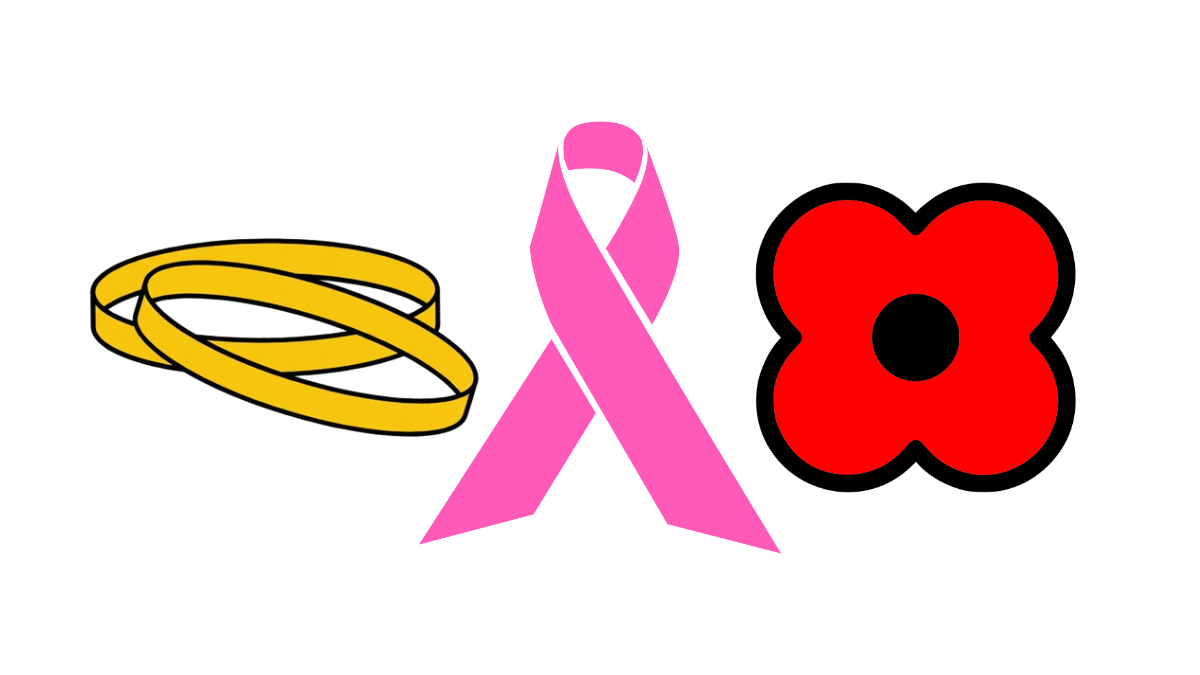
In 2004, Nike and the Lance Armstrong Foundation began to sell a bright yellow silicone bracelet with the word "Livestrong" on it for $1, to raise money, support, and awareness for cancer research and survivors. Over the next few years, silicone bracelets in a veritable rainbow of colors became ubiquitous, with every charity and non-profit attempting to brand their own niche through the use of color.
In 1979, Penne Laingen, the wife of a diplomat, Bruce Laingen, held captive in Iran, wrapped yellow ribbons around trees in her yard, transforming the yellow ribbon into a symbol of hope and safe return. The yellow ribbon was resurrected during the Gulf War for soldiers. In the early 1990s, AIDS activists chose the red ribbon to raise awareness for nearly 100k gay and bisexual men who died during the first decade of the epidemic. Subsequently, the Susan B. Komen Breast Cancer Foundation distributed pink ribbons to breast cancer survivors and runners in the 1991 Komen New York City Race for the Cure. Now, every cancer has its own color ribbon which are worn by survivors and supporters alike.
In 1921, artificial red poppies were first manufactured by the Poppy Lady from France, Anna E. Guérin, and sold to support the families of Allied fallen soldiers and veterans from the First World War. In the century since, there have been white poppies are sold by the Peace Pledge Union to symbolize peace without violence, the purple poppy is worn to remember animals killed or injured in war, and the black poppy is worn to recognize the contributions of Black communities to the war efforts. In French, they wear the bleuet de France, a blue cornflower, as a similar symbol to the red remembrance poppy.
Each one of these inexpensive physical objects underwent a similar transformation. They were first adopted for a very particular cause, with a very specific color. And subsequently, as they became popularized, the item was borrowed by other groups who recreated them in colors meaningful to their own movements.
The ubiquitous nature of the objects is the meaning.
Not a single word is needed to express support of a cause. Though, there is an inherent problem with semiotic items such as these. I cannot wear a red poppy with a different meaning in mind, because my personal intent is irrelevant. The passerby who sees someone wearing a red poppy will assume its meaning, and assume the wearer's associated support.
Similarly, there is no nuance available with such symbols. While the red remembrance poppy began as support for all the Allied forces in World War I, its meaning has largely been expanded to include support for soldiers who have died in other wars as well. Since 2014, Ukrainians wear the poppy as a symbol of the victory of Nazism. In Ireland, many have replaced the red poppy with a "shamrock remembrance poppy" in order to remember the lost without supporting the symbol of the British military.
Evolutions in meaning may happen even more rapidly.
The doping scandal surrounding Lance Armstrong in the early 2010s led to the rebranding of his foundation as the Livestrong Foundation in 2013. The bright yellow bracelet which once promoted resilience quickly became associated with cheating.
In 1963, immediately following the assassination of US President John F. Kennedy, people worldwide, including the Royal Guards and British football clubs, wore black armbands out of respect for his memory. (As I wrote a few years ago, the practice of Black Friday is directly related to that event, so it is only right that the UK retailers now celebrate with the same enthusiasm as US retailers.)
But in 1965, just two years after his assassination, students in Des Moines, Iowa wore the same black armbands to mourn the casualties of and protest the Vietnam War, leading to the landmark U.S. Supreme Court case Tinker v. Des Moines about the First Amendment in 1969.
On their own, a silicone bracelet, a piece of ribbon, and an artificial poppy each have no inherent meaning. A color on its own is also not necessarily meaningful. This is to say, a pink scarf does not have the same meaning as a pink ribbon.
But a colored silicone bracelet, a piece of colored ribbon, and an artificial colored poppy will now always have semiotic meaning, even if the particular meaning related to the specific color is somewhat ephemeral. One cannot wear a piece of colored ribbon or an artificial colored poppy without other people wondering about its meaning.