Of Saints and Dragons
Slaying dragons seemed to be a popular pastime for Christian saints.
Note: This will be my last post from Urbino for the time being. I'm leaving on Monday, and will be spending Passover in Cambridge, England. I figured I should close the loop I began with the first post I wrote from Urbino.
It is my opinion that the painting by Raphael which hangs in the National Gallery of Art in Washington, D.C. featuring a knight slaying a dragon was not initially titled "Saint George and the Dragon", nor was it originally intended to represent the patron saint of England, Saint George.
Instead, I argue that the saint portrayed there is Saint Crescentinus, the patron saint of Urbino, with the then-Duke of Urbino as the inspiration for the rider.
Saint Crescentinus, like Saint George, was a Roman solder best remembered for murdering a dragon in the early 4th century, both having died in 303 CE.
Honor
The work was painted to honor Guidobaldo da Montefeltro, the 3rd Duke of Urbino, and his induction into the Order of the Garter. As King Henry VII would never see his actual knight Duke Guidobaldo in person, the painting was a rendering of his acceptance of the honor.
This painting was sent along to England with the Duke's emissary Sir Balthasar de Castiglione, alongside three prized Urbino falcons, as a gift for the king. It demonstrated how honored Guidobaldo was to be chosen.
In this painting, we see how Raphael honored his lifelong friend and patron, Duke Guidobaldo, by visually connecting him to both the patron saint of the city he now protected, and to the father from which he learned how to be a good leader to the city.
Like Father, Like Son
Guidobaldo's father Federico was renowned for his military prowess, never having lost a battle. He was first inducted into the Order of the Garter in 1474, a few years after his victory at Volterra for Lorenzo de' Medici.
He had been voted in on 26th of February, but not officially elected until the 18th of August. On the 20th of August of 1474, he also became both a Knight of St. Peter and a Duke by Pope Sixtus IV. In September of 1474, he was also installed as knight by the King of Naples as a member of the Order of the Ermine.
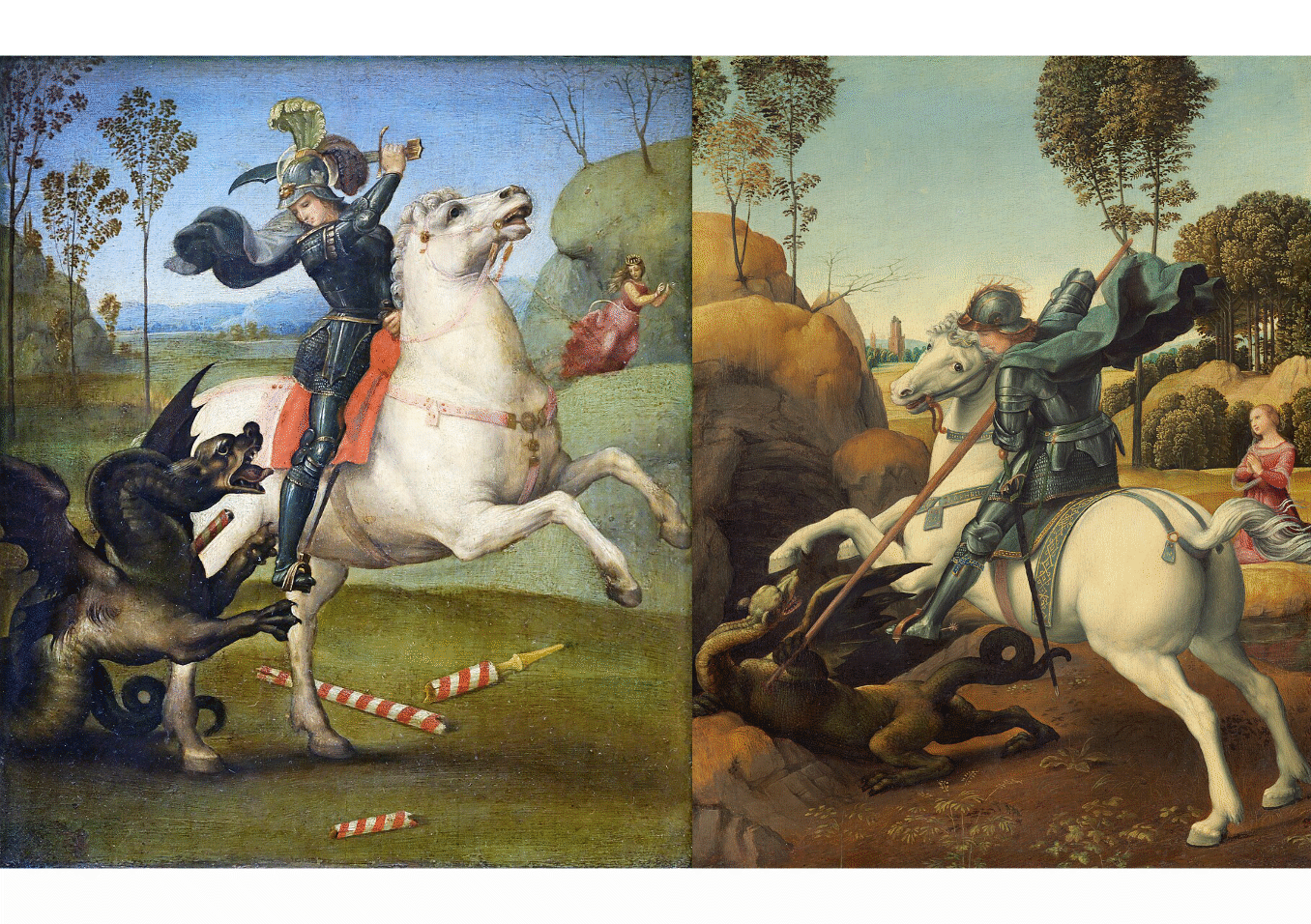
When I first arrived in Urbino, roughly 2.5 months ago, I wrote about Raphael's two versions of Saint George and the Dragon. In that piece, I noted that
[T]here are several stylistic, figurative, and narrative differences between the two works, the most prominent of which is the blue garter around St. George's in the latter piece. Rafael's patron, the Duke of Urbino, was inducted into the Order of the Garter, and the commission of this painting was meant to honor that.
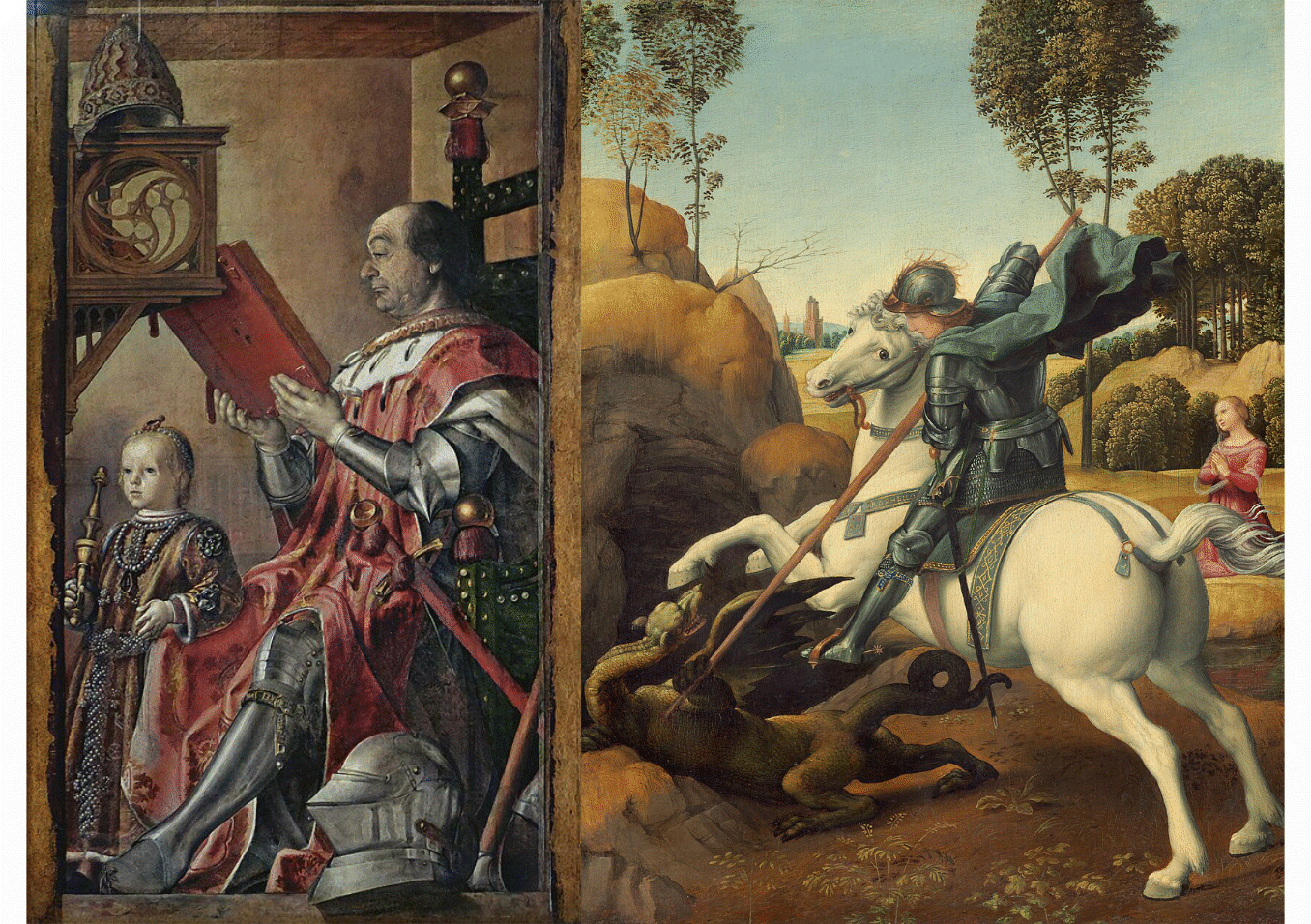
In the Galleria Nazionale della Marche which is located in the Palazzo Ducale, there is a painting of Duke Federico reading, with young Guidobaldo also featured. And around Federico's left leg is the same blue garter which Raphael would paint around the sainted dragon murderer's leg decades later.
Portrait Mode
It's more than simply the timing of the commission, but also the subject. When we compare the painting with a portrait done of Duke Guidobaldo from the same period, we see that the knight in fact, is Guidobaldo.
I would also contend that those buildings in the background represent the city of Urbino. They are not present in the "first" painting of St. George painted by Raphael.
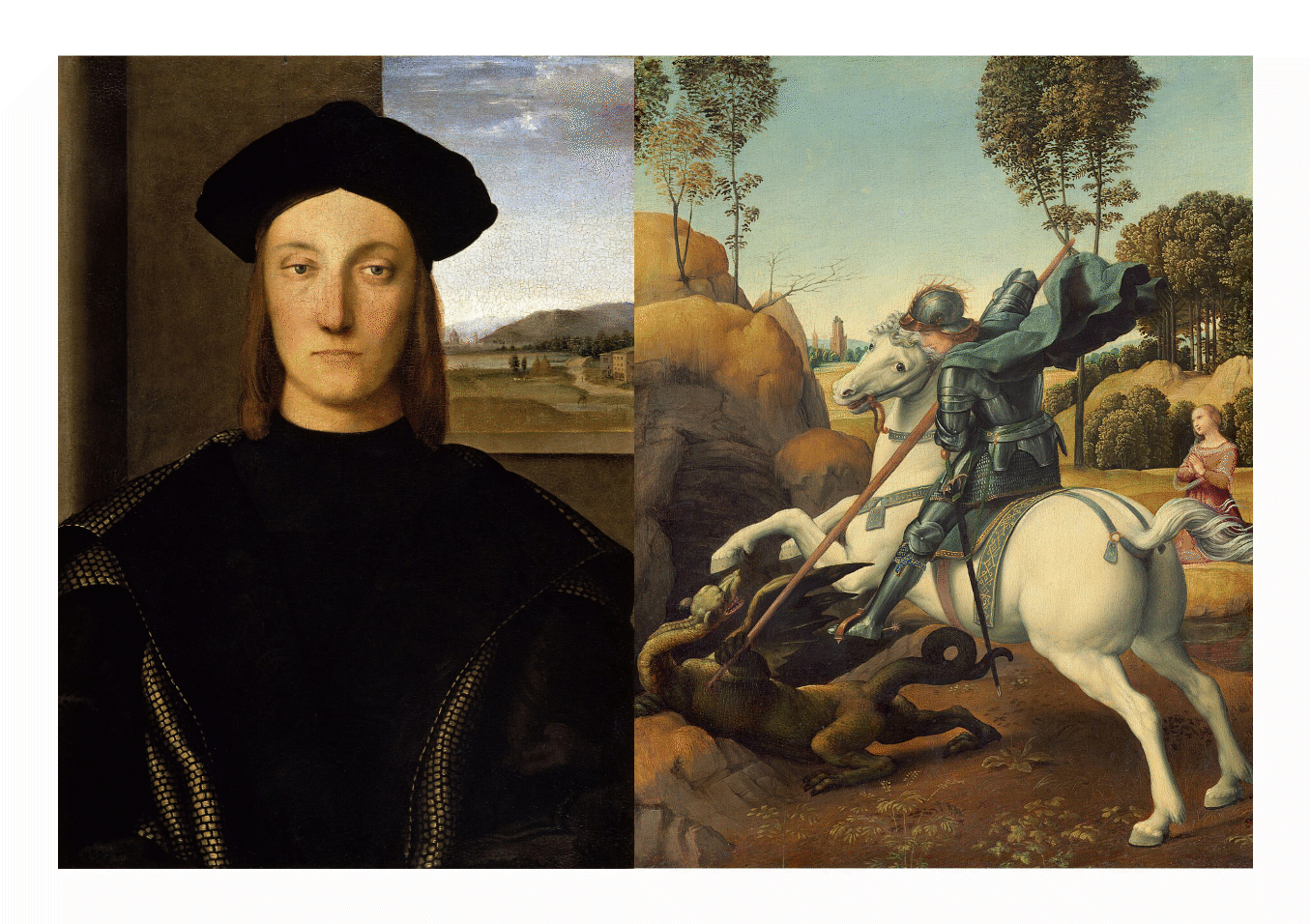
It would appear that both two works were painted from exactly opposite points surrounding the city.
Urbino Guado (Italian woad)
One of the differences between Raphael's Saints George is that all the coloring of the horse's saddle and accoutrement in the second one is light blue, which is not the bright red color associated with St. George in every other depiction of the character.
As I noted in my newsletter earlier this week, that would make sense if it was intended to highlight the valued resource of the Duchy of Urbino.
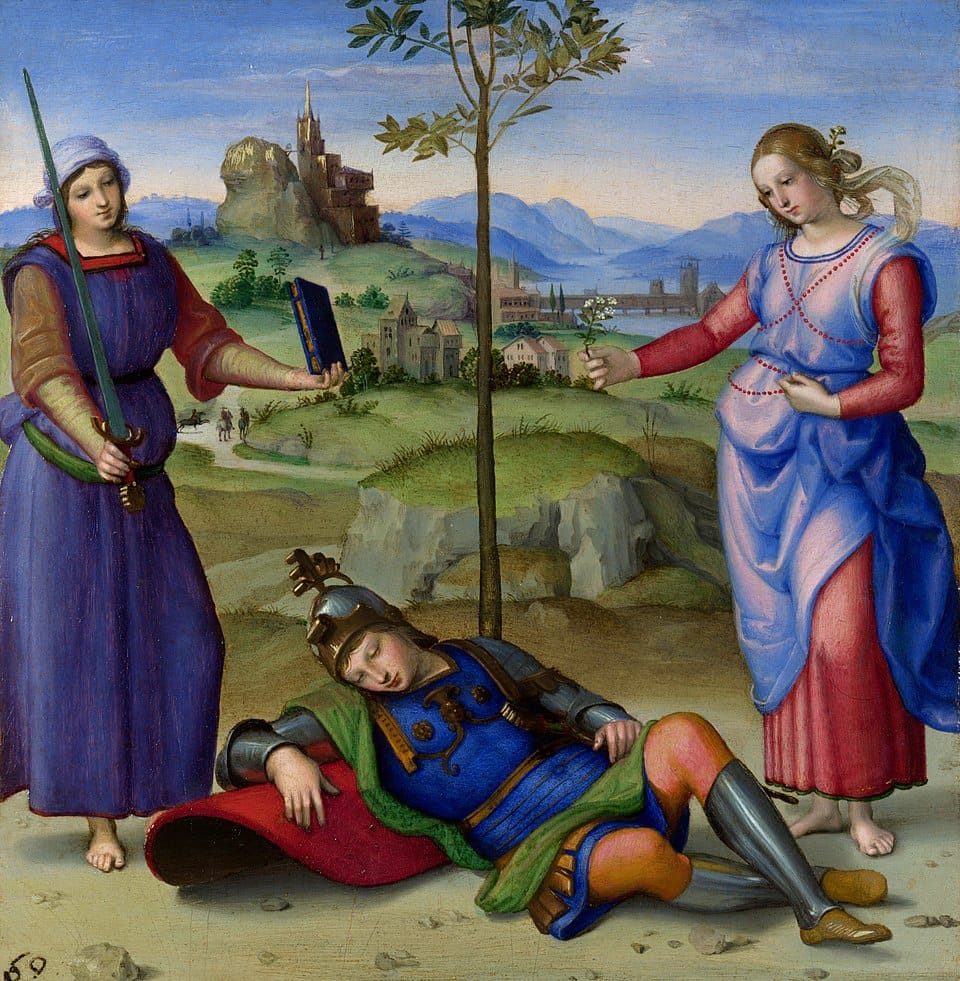
As an addition to that newsletter, we can also see the use of varying shades of guado in the outfits of all three characters in Raphael's Vision of a Knight, with the city of Urbino in the background. This would underscore that they would have had different names to describe each dyed hue.
 Ezra Butler
Local Saint
After Duke Guidobaldo died, his nephew, the next Duke of Urbino, Francesco Maria I della Rovere even minted a coin featuring Saint Crescentinus on it. And still today, there is a local typical food which bears the name of the saint.
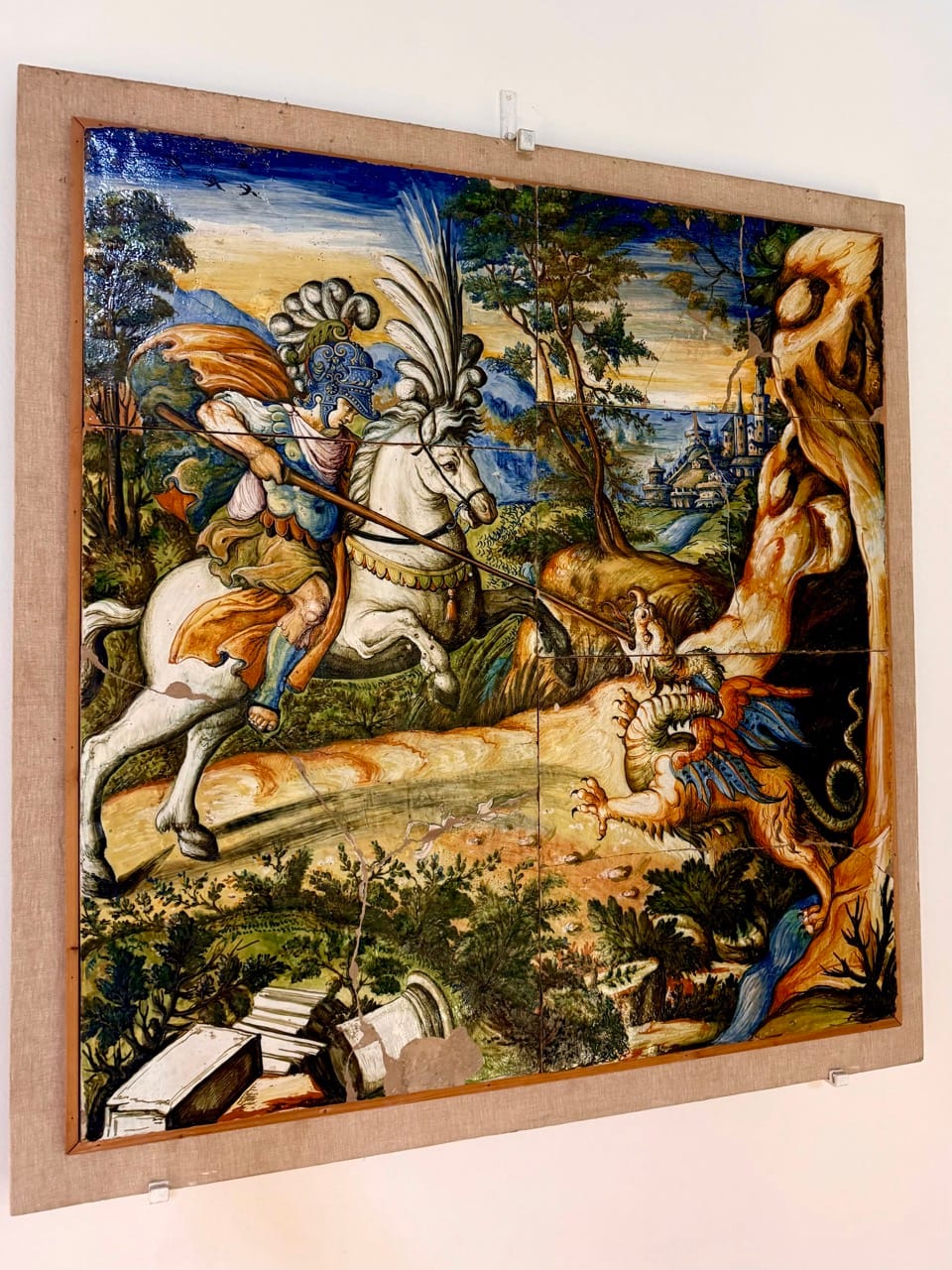
If we look at the work created by Gironimo Tomasi of Saint Crescentinus from roughly 70 years later, it is clear that his preferred weapon was a lance, similar to Raphael's version in the National Gallery of Art, and unlike to the version which is currently found in the Louvre.
Saintly Switch
Who switched the name of the saint and why? I don't know. Maybe it was easier to just pass it off as another version of the more recognizable saint with the simpler name to English speakers. Maybe people just assumed because of the blue garter, and it was given in honor of the induction.
It was a shared tradition of Urbino and England: they were both protected by dragon murderers.
Minor Correction
There is a line in the Wikipedia entry for the painting in question which deserves a correction.
The honour paid to a minor Italian ruler reflected Henry's appreciation of the cultural prestige of Renaissance Italy as much as any diplomatic purpose.
It cannot be overstated how much this was a very politically connected family. Guidobaldo had fought as a captain for Pope Alexander VI. Guidobaldo's successor was his nephew, who was also the nephew of Pope Julius II, the child of a union which occurred around the time Federico was inducted into the Order of the Garter.
But Federico wasn't originally inducted into the Order of the Garter because of all of his patronage of the arts and sciences. He was inducted because King Edward IV was at war and needed allies. Remember that when Lorenzo de' Medici needed to take control of a city, he went to the top condettori whose name inspired respect from his troops and fear from its enemies. That was Federico.
This "minor Italian ruler" was connected with Florence, Naples, and Rome.
While there were more explicit requests, like favors from the Pope which were extracted via the induction. Additionally, Edward IV was able to collect a sizable payment from King Louis XI of France with the Treaty of Picquigny to withdraw in 1475. It could be argued that Louis XI saw a losing fight, especially if he had to contend with Duke of Urbino coming up from Italy.
His (ultimate) successor Henry VII seemed to want to maintain this positive relationship with the Pope, by proxy.
Both King Henry VII and Duke Guidobaldo died within a year of each other, thus severing the warm relationship between England and Urbino, and by extension, the Pope, until now.
Have any color-related question or curiosity? Supporters with paid subscriptions may email me a question, and I'll research and write a 750-1500 word response.
Please consider a paid subscription to help support my research, or get a free subscription and consider giving a one-time tip.