Chasing the Blue-Green Dragon
From Raphael's Saint George and the Dragon, through Sir Gawain and the Green Knight, and past Robin Hood, and back again.
I'm writing this the medieval commune of Urbino, Italy, the birthplace of Raffaello Sanzio da Urbino, better known to English speakers as Raphael. Why am I here? Feel free to read the post I wrote on my recently-resurrected personal website.
 Ezra Butler
In English, the dragon is often used as a metaphor for a difficult challenge. For me, the dragon to be tamed is trying to figure out what color people were talking about in the 11th to 15th centuries when they referred to something as green.
Blue Garter
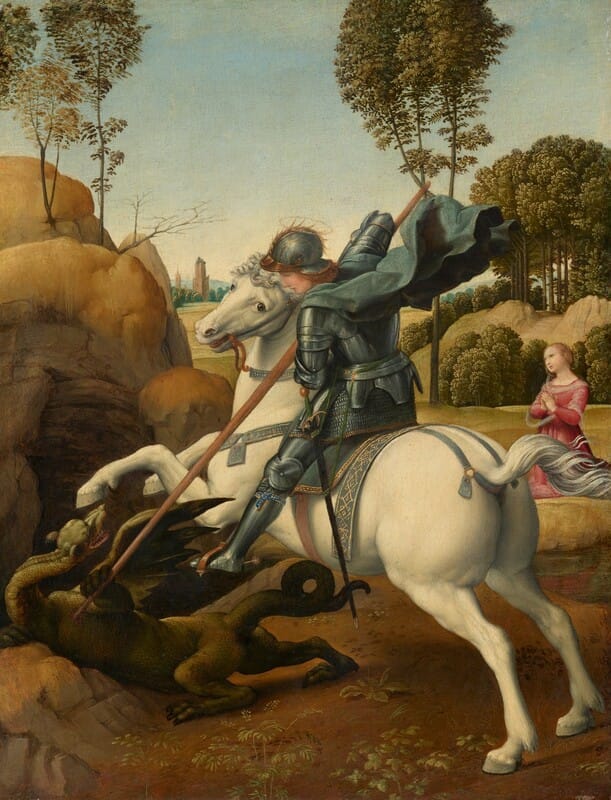
I should probably begin with something related to Raphael. Among his masterpieces, between 1503 and 1506, Raphael created two versions of St. George and the Dragon.
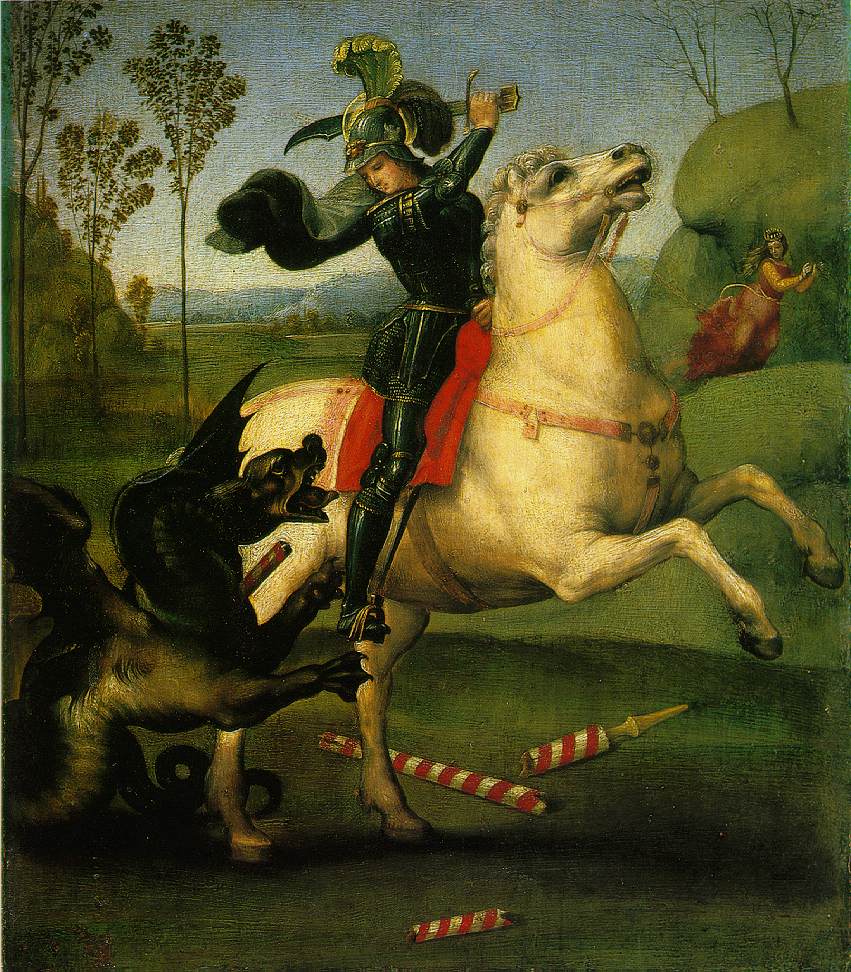
There are several stylistic, figurative, and narrative differences between the two works, the most prominent of which is the blue garter around St. George's in the latter piece. Rafael's patron, the Duke of Urbino, was inducted into the Order of the Garter, and the commission of this painting was meant to honor that.
The Order of the Garter was said to be founded around 1348 by King Edward III of England. Like his grandfather, King Edward I, he was obsessed with the myth of King Arthur and the Round Table, to the extent where, a decade, he commissioned an actual round table be built. He likely believed that King Arthur actually existed and had a round table. It's a great case of a myth becoming reality.
The phrase written on the Garter is the Latin, "Honi soit qui mal y pense" meaning "Shame on him who thinks evil of it". There is a whole narrative invented which explains the chivalrous nature of some knight discovering a garter or something to that extent.
One of the strangest features is that the order took its symbol from an item of ladies' underwear. The story of how Edward III, at a ball in Calais, retrieved the garter of the Countess of Salisbury (allegedly his amoureuse) and bound it on his own knee saying 'Honi soit qui mal y pense' is apocryphal. It began, however, to circulate from an early date.
Green Garter
A more likely origin to the term comes from the 14th century myth of magical realism and chivalry called Sir Gawain and the Green Knight. This story said to be older than the original book as well, and borrowed from Welsh, namely, that the Green Knight was original a knight with blue-green eyes.
In the earliest versions of the myths about the Green Knight, one of the earliest "villains", the word used to describe him was glas, which was likely his eye color, connected with one of the first pieces I wrote about Glaucus and that time I learned Welsh colors. It's a blue-green.
The mistranslation caused people to start to wonder "what made him green?", and began to portray him in green clothing, and also green skin.
 Ezra Butler
(Please ignore the magazine which never got off the ground.)
The book concludes with the line "Hony soyt qui mal pence". In my opinion, this predates the Order of the Garter, which would make sense that Edward III would borrow again from Arthurian myth in order to launch his group, just as he did a decade earlier with the Round Table.
In fact, from the final paragraph of the book, it does seem that the entire myth was constructed to give a reason why knights wore some sort of green garter, and what that had to do with chivalry. Which would indicate that there was already an established practice of knights wearing an article of lingerie, predating the Order.
That lordes and ladis that longed to the Table,
Uche burne of the brotherhede, a bauderyk schulde have,
A bende abelef hym aboute of a bryght grene,
That lords and ladies who belong to the Table,
Each member of the brotherhood, should wear such a belt,
A baldric of bright green crosswise on the body,
– Sir Gawain and the Green Knight - 2515-2518
(Edited and translated by William Vantuono)
Green is obviously the operative color in Sir Gawain and the Green Knight, as it seems to be in the Geste of Robin Hode, another late 15th century book, which also was based on much earlier material.
Lincoln Green
Anyone who has heard of Robin Hood is quick to associate him with Lincoln Green. During my somewhat extensive research on Robin Hood, the city of Lincoln, and the English fabric and dye manufacturing industries during the 13th and 14th centuries, it became somewhat apparent that Lincoln Green never existed.
The only contemporaneous colorful Lincoln fabric ever explicitly stated in a document was a scarlet from Lincoln that the King sent to the queen of Norway.
In 1240 the guardians of the bishopric of Winchester were bidden to buy at Winchester fair two pieces of Lincoln scarlet cloth for the use of the queen of Norway, as a gift from the king.
In fact, for much of the time I was researching, I wanted to say that Lincoln Green was really Lincoln in grain, ie. red.
Some scholars disregard that because outlaws wouldn't wear expensive red, but the time it is most apparent is in the final fytte (section) of the geste, in which the king and his men come out of the forest clad in Lincoln Green, which seemed to be a sight to behold.
Whan they were clothed in Lyncolne grene,
They keste away theyr graye,
"Nom we shall to Notyngham,"
All thus our kynge gan say.
422
All the people of Notyngham
They stode and behelde,
They sawe nothynge but mantels of grene
That covered all the felde.
427
People wearing green would camouflage in with the forest, not stand out.
Red Knights
This is relevant as this part was after Robin Hood discovered that the king was actually the king. Speaking visually, the king and his entire entourage coming out of the forest in a beautiful red would stand out.
We know that red would actually be a color worn by people in the king's employ. If you look at the original 14th century manuscript from Sir Gawain and the Green Knight, Sir Gawain is dressed in red. As does the actual text:
The gordel of the grene silk, that gay wel bisemed,
Upon that ryol red clothe that ryche watz to schewe.
The girdle of green silk, whose colour went well
Against that splendid red surcote that showed so fine.
– Sir Gawain and the Green Knight - 2035-2036
(Edited and translated by William Vantuono)
The main problem with the theory that the king's entourage wore red, and therefore if Licoln Green were actually a "grain" red hue, then people would have realized that it was the king coming out of the forest. And yet, they thought the king had been slain.
Than every man to other gan say,
'I drede our kynge be slone;
Come Robyn Hode to the towne, i wys,
On lyve he lefte never one.
428
Green / Blue Hues
In general, the Middle English language in Sir Gawain and the Green Knight was bifurcated between the higher class speaking French rooted words, which the lower classes would speak Anglo-Saxon words.
When I was reading through a bilingual version of Sir Gawain and the Green Knight, I noticed a color being described in Modern English as emerald. This was a mistranslation. The original read "enker-grene", ostensibly from the French verts encre (ink green), which sounds very similar to Lincoln Green.
I recently discovered some letters for a large fabric order in Italian (translated to French) from 1294 which can give us a little more context. This includes drapes in the following shades:
- verdi encri / verts encre / ink green
- verdi smiraldini / verts émeraude / emerald green
- persi encri / pers encre / ink perse (persian blue)
- azurine / azure
- celestrine / celestés / celeste or sky blue
- persi / perses / persian (blue)
- bioi / bleu / blue
- fistachini / futaines
Fistachini is interesting. The author of the article translates as "futaines" or "fustian" in English, which is a type of fabric, but I believe that it is referring to pistachio. But in that case, it would mean a yellow-green fabric, which would be similar to all the other distinct hues they are mentioning.
Just to remind you: This isn't some literary reference in which writer is trying to use a color metaphorically, this is an actual fabric order.
Ink Color
But should encre even mean "black" or "dark" like we think of ink? The word comes from the Latin encaustum, which is the burnt color, as opposed to the atramentum which was the black ink.
This would create the possibility that it could be the color of dried gall-based inks. Is it the color verdigris, which seemed to have some alchemical characteristics, sort of like gall-based ink, which would dry green, not black? Or is the inky aspect of the dye referring to its opacity, similar to the "twice-dyed" idea.
Hell-Blue
For some reason, I have a (probably) wrong theory that it's related to the Middle German dunker (if we misread it as d'encre) which meant dark. In German it would be dunkel which also has the connotation of hell.
Which becomes somewhat funny when you realize that there is a color called bleu d'enfer, which literally means hellblue, before it was changed to "navy blue".
Even more, the green devil is a concept which we see in both Chaucer (a yeoman dressed in green who admits to being the devil) and elsewhere, which some scholars try to connect back to The Green Knight.
Woad and Dyer's Weed
Or is this all related to the whole debate about the color of biblical blue and its place on the green-blue spectrum. We've already see that the Jewish French 12th century sage Rashi conflated the colors blue and green when describing tekhelet.
 Ezra Butler
What is ink is somehow related to woad (blue dye), and the difference between the blue and green versions is if the dyer included a yellow dye (from dyer's weed) to temper the blue. So, Lincoln Green (read: Ink Green) would actually be a shade of blue-green.
This would work very nicely, in fact, especially if the Green Knight was originally someone with blue-green eyes and coloring, which means that Sir Gawain would be wearing a blue-green garter, which would then become the blue garter that Rafael would end up painting on the the second version of St. George and the Dragon.
Enjoyed this newsletter?
Please consider making a small one-time tip to help support my research.