The Color of Alexandrian Peacocks
or "The Case of the Missing Dye"

Part of studying history is looking for what isn't there. If you discover what is missing, it won't magically answer all of your questions. To the contrary, it will force you to ask questions about things that you've long taken for granted.
During my time here in Urbino, I've done a significant amount of research on the 2nd Duke of Urbino, Federico da Montefeltro, who was responsible for building most of the current city, and was renown as a patron of the arts and sciences during the Italian Renaissance.
I've also disovered that Marche, the greater region in which Urbino is located, was central to the medieval production of guado, or Italian woad.
I would love to write about the impact of guado on the commerce, art, fashion, and culture of the Renaissance. I would love to highlight the pride that the people living in this region at that time held towards the natural dye which grew wild in much of the region.
But there is a slight problem. Every theory that has developed about the Renaissance has been filtered through what early scholars have written in all fields. What would have happen if we've always told the story of the Renaissance without the guado dye? What if the blue which most people connect with the Renaissance is the imported oltremare (ultramarine blue) pigment?
Stuck in 1851
It can be said that Montefeltro's most preeminent biographer was James Dennistoun of Dennistoun, who in 1851 published a set of three books titled Memories of the Dukes of Urbino: 1440 - 1630. As far as I can tell, this is the most comprehensive study of the dukes of Urbino. To that end, in 2010, the set was even translated into Italian, with many of the quoted sources presented in their original languages, as opposed to Dennistoun's English translation.
Elsewhere in the world, 1851 was the near height of the British indigo trade, a half-dozen years before the Indian Mutiny of 1857 against the rule of the British East India Company, and the 1858 creation by the British Crown of the British Raj.
With indigo at that time being synonymous with wealth, it is quite curious that in more than 1000 pages of well-sourced research and engaging writing, that Dennistoun would not mention the word "woad" or "guado" a single time.
How could he forget about the value and importance of the dye?
Where's the Guado?
The Montefeltros were involved, to some extent, in the guado trade. According to one book I read, there was even a woad-drying room in the Data, which were the large medieval stables built into the wall of the city of Urbino. Though, I don't know to what extent.
Within moments of learning about local guado industry, many things began to make sense. For instance, why the coat of arms would be alternating stripes of gold and blue. In Appendix V of Volume 1, he even writes
[A]s these badges are constantly met with in architectural decorations, medals, and illuminated MSS, it is useful to possess an index to their ownership, though not always to their occult meaning.
I would suggest that the deep occult meaning of the centrality of azure was to honor the guado.
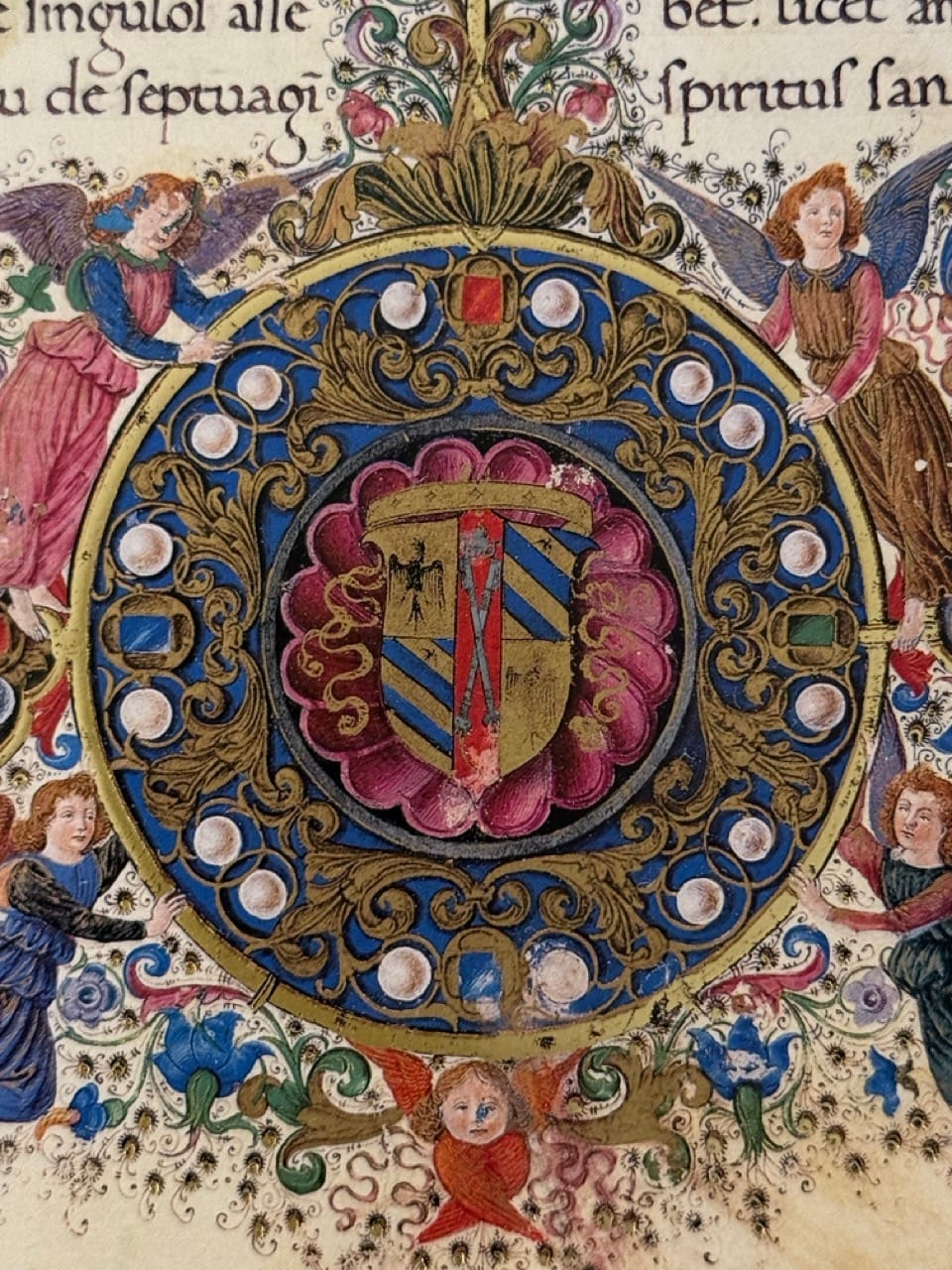
In fact, the blue dye shipped by the Genoese traders to England would have most likely been the product of this region. Which still allows me to maintain that the Genoese did not import Guinea fowl to England, rather the fowl shared the color of the imported dye.
 Ezra Butler
Unconventional Fashion
If this is all correct, then one would assume that the guado (Italian woad) dye would be valued and held in high esteem by both the inhabitants and nobility of the region alike.
This leads me to the list of clothing brought by Duke Federico da Montefeltro's half-sister Brigida Sueva to the convent of Corpus Domini in Pesaro. Brigida had married Alessandro Sforza, Lord of Pesaro, in 1448, in a political union, but fled to live in a convent around 1460 due to her husband's brutality and abuse.
As Dennistoun noted
That she did not leave behind all mundane tastes may be concluded from a curious inventory of paraphernalia which she took into the cloister, printed by the Abbé Olivieri from the original in her own hand.
pp. 43-44
He included the appendix of items translated to English in the Appendix II titled INVENTORY OF ARTICLES TAKEN BY BRIGIDA SUEVA DI MONTEFELTRO, ALIAS SISTER SERAFINA, INTO THE CONVENT OF CORPUS DOMINI.
While I have questions about many of the items, there were two color-words in particular which puzzled me: Purple and Alessandrine.
– 6 trimmed tissues, one purple, one alessandrine, one green...
– 1 purple brocaded dress ;
– 1 small brocaded cloak, alessandrine coloured ;
pp. 414-415
Considering that Sister Serafina was writing this in 1460, right after the Fall of Constantinople, I was wondering what word she would use to describe purple in Italian. Was this the purpura, ie. so called "royal purple", or something a bit more local?
Also, I was unsure if alessandrine was the word that would be used to describe a color in mid 19th century England or in mid-15th century Pesaro. So, I've tracked down a copy of the Olivieri's version in Memorie di Alessandro Sforza (1785) to identify the original language used.
– It. tessuti forniti. 6. Un paonazzo un alexsandrino es un verde...
– It. un vistito brocato paonazo
– It. una mantellina brocat. Alessandrin.
pp. LIII - LIV
What color is a peacock?
A pavone (or paone) is a peacock, so paonazzo would be "resembling a peacock".
A peacock is a beautiful blue color. I know this because I've seen peacocks.
Which Alexandria?
Alessandrino is Alexandrian, which could refer to one of four things:
1. Alexandria is a city in Egypt, so alessandrine is an Egyptian Blue. Elsewhere, we've seen turkeys being described as avis Pharaonis for this same reason.
2. The dyed material is literally imported from Alexandria, Egypt.
In a later appendix, in a footnote on Giovanni Sanzi's poem in honor of Federico da Montefeltro's 1474 installation into the Order of the Garter, the translator in the Italian edition (2010) writes
L'azzurro oltremare dei velluti serici di Alessandria d'Egitto
The ultramarine blue of silk velvets from Alexandria, Egypt.
note 25, p.369
3. It is referencing Alexander Severus, the youngest emperor of the Roman Empire who conquered Persia in the early 3rd century, and would have brought back the the light Persian Blue color to the Empire, and then associated his name with the color.
4. It is referencing a fabric from Alessandria, a city in Piedmonte.
Maybe everything is guado (Italian woad).
One thing which is curiously not anywhere on the list is anything listing its color as guado (Italian woad). Just like we would say a crimson dress or an indigo cloak, one would expect for a noblewoman from the Montefeltro family, to have something made with the highly valued local product.
Unless, of course, paonazzo, alessandrino, and maybe even verde are all fabrics dyed with Italian woad.
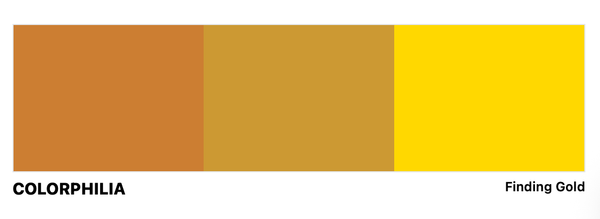
My preferred theory is that paonazzo is the deep, bright blue, and 100% from Italian woad. We would later see in the paonazzo represented in Renaissance artwork from the Marche region depicting the Virgin Mary, which people tend to associate with the pigment that is use to paint it, the lapis lazuli or oltremare (ultramarine) blue.
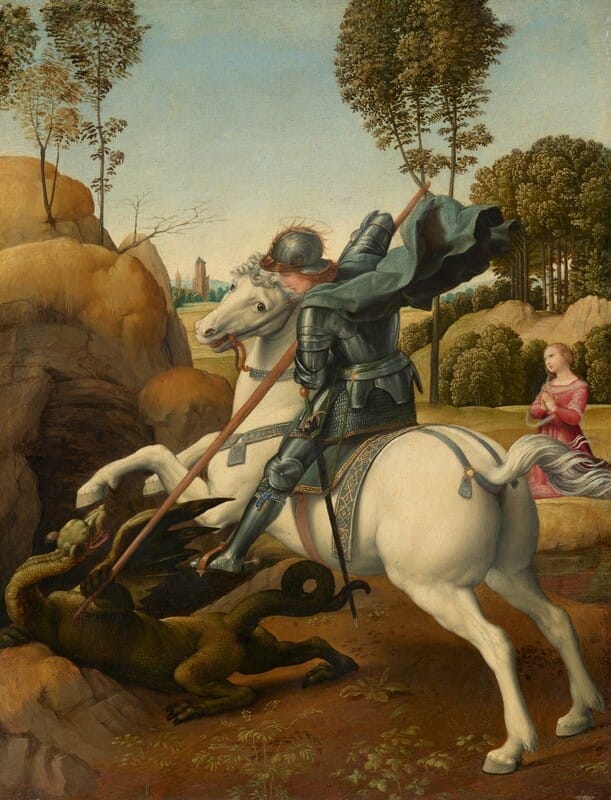
Alessandrino is a medium-hued blue, also 100% Italian woad, but left in the vat for a shorter amount of time or diluted in some way. For example, how would they have have described the color of the cape and saddle in this painting by Raphael?
Meaningful Names
Something to remember is that this is a functional list written by a real person, not some fiction or even fabric order. Assuming we are talking about clothing dyed with local Italian woad, whether pure or blended with something else, the question is why did they name it the way they did.
A peacock was beautiful and prized.
Similarly, using a name inspired by ancient Alexandria was as aspirational as dressing like a beautiful peacock. At least in the decades following this compilation of this list, Urbino sought to be the New Alexandria, the wealthy epicenter of culture, art, science, and scholarship. As an undefeated military leader, the Duke of Urbino may have later even seen himself as a version of Alexander the Great.
More questions
When coupled with our perennial misunderstanding about the origins of Ultramarine, Dennistoun's complete omission of guado (Italian woad) makes me wonder about many more things.
 Ezra Butler
- What does this mean about the fashion depicted in Renaissance art which is represented with ultramarine blue?
- How much of the Montefeltro wealth was derived from the trade of guado (Italian woad)? How was the system compared to Toulouse from the same period, or India during the mid-19th century?
- Once inducted into the Order of the Garter, did either Duke Federico da Montefeltro (or his son Duke Guidobaldo) provide the British monarchy with any Italian woad?
- Where else is some color name simply a particular shade of a specific dye? Suppose theoretically that it took two days of steeping fabric in dye for paonazzo and only one day for alessandrino, but besides for that, the process and materials were all identical. Are there similar names for madder or dyer's weed?
- Was there at least one item dyed with guado (in whatever particular hue) in the medieval corredo (bridal trousseau) of everyone in the region?
Have any color-related question or curiosity? Supporters with paid subscriptions may email me a question, and I'll research and write a 750-1500 word response. Please consider a paid subscription to help support my research, or get a free subscription and consider giving a one-time tip.