The Vexing Evolution of Flags
Tracking the color blue on flags through the centuries.
Earlier this week, I happened to see the Puerto Rican flag.
Curious about its origins, I noticed that an earlier version of the flag had a much lighter shade of blue. This, of course, led me down a rabbit-hole into the history of flags, and how they evolve. To that end, I discovered some fascinating articles from 1915 and 1929 about the American flag, which I quote from below.
And as I never have any idea where something will lead, one of the articles mentioned a myth about a 10th century King of the Scots, which obviously reminded me of Constantine the Great. Which brought me back to rethink the meaning of the Nika riots in Constatinople in 532 AD.
Puerto Rico
The Commonwealth of Puerto Rico is currently a territory of the United States.
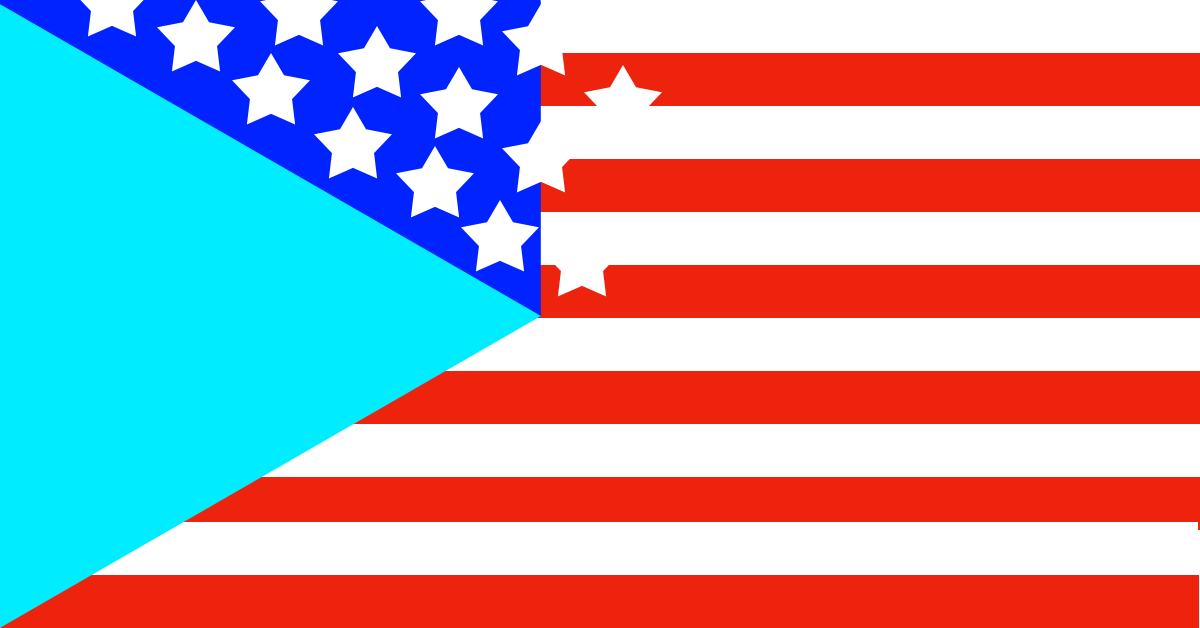
The 1895 version of the Puerto Rican flag featured a much lighter shade of blue. Then dark blue (azul oscuro), incidentally the same color as the flag of the United States of America, replaced light blue (azul claro) in 1952, and medium blue (azul medio) replaced dark blue in 1995. And in 2022, they unsuccessfully attempted to define the current shade with the term royal blue (azul royal).
The 1895 version was said to have been designed by the New York-based exiled members of the Revolutionary Committee of Puerto Rico. As Wikipedia notes:
some historians have presumed members adopted light blue shade based on the light blue flag of the Grito de Lares (Cry of Lares) revolt
The problem is that there exists an authenticated, original 1868 Grito de Lares flag with a darker indigo from when Puerto Rico initially tried to declare their independence from Spain. The versions of the Grito de Lares inspired flag which have a light blue were from the early 1930s, which may have been influenced by the colors of the above-mentioned 1895 flag.
Philippines
A similar question of exact hue of blue (between a medium blue and dark blue) can be asked about the original design for the 1898 flag of the Philippines, by General Emilio Aguinaldo, who later became the first president of the Philippines, following the Treaty of Paris in which Spain ceded its claim on the Philippines to the United States.
The Philippine-American War followed, in which hundreds of thousands Filipinos died, and resulted in the American occupation of the Philippines.
Sky Blue
I wondered if the sky blue flags could be found elsewhere in the Americas.
The answer is yes, at least in the early 19th century. There are at least two examples:
- The escarapela argentina (the Argentine Cockade) from 1810-1812, which was blanco y azul celeste (white and sky blue), which then matched the same colors of the flag designed by (the somewhat) devout Catholic Manuel Belgrano, the son of an Italian merchant from Liguria who married into one of the wealthiest families in Argentina?
- The light blue and white stripes of the 1828-1830 flag of Uruguay, immediately following its independence, before shifting to a darker hue.
The colors of blanco y azul celeste (white and light sky-blue) mirrored the colors of the 1771 Order of Carlos III, a Spanish knighthood, which were different than heraldic blue, red, and gold of the House of Bourbon-Anjou.
Light sky-blue is synonymous with clear (and therefore pure), an idea which can even be found in Latin texts in Late Antiquity, and arguably back even even earlier. This would suggest that the choice of light sky-blue would originally have had religious significance, specifically for countries who had been colonized by Spain.
Blue Blood
The term "blue blood" was mistakenly attributed by a French travel writer in the early 1820s to the Spanish and their obsession with hidalguía (nobility by blood) and their discriminatory estatutos de limpieza de sangre (purity of blood laws) which they implemented after the forced conversion or expulsion of Jews (and later Muslims) after the completion of the Reconquista (reconquest) with the capture of Granada.
The travel writer likely heard the phrase "sangre su" which is a shortened version of "sangre su derecho" which means "[your] blood is your right" and he misheard "sangre azul".
In fact, the well-known late 16th century English bard, William Shakespeare, first used the phrase "blue blood" in an epic poem:
In her the painter had anatomized
Time's ruin, beauty's wreck, and grim care's reign:
Her cheeks with chaps and wrinkles were disguised;
Of what she was no semblance did remain:
Her blue blood changed to black in every vein,
Wanting the spring that those shrunk pipes had fed,
Show'd life imprison'd in a body dead.
– The Rape of Lucrece
United States
In 1915, during World War I, right before when the American President Woodrow Wilson issued a presidential proclamation designating June 14 as Flag Day, an article was written in The Proceedings of the New York State Historical Association by Harlan H. Homer, simply titled "The American Flag".
The American Flag
In it, Homer traces the history of flags which have been flown in North America since John Cabot, a Venetian in 1497 planted a flag of England (the red cross of St. George, on a white background) and one of St. Mark (in honor of his Venetian heritage) on Newfoundland.
Apropos to nothing, Newfoundland has city called Gander, home to Gander International Airport, which hosted 38 airplanes who were diverted from landing in the US on September 11, 2001. The kindness they showed to strangers was later documented in the Tony-award winning musical COME FROM AWAY.
He continues to how when in 1603 James I of England combined the St. George flag of England with the St. Andrew flag of Scotland to form the King's Colours, but figures that the Mayflower likely flew only the St. George flag on its journey to the New World. In 1707, after rather tumultuous century, they created a new flag, the Meteor flag of England, which combined the St. George flag of England and Wales, and the St. Andrew flag of Scotland.
Homer goes on at some length (as the article is 15 pages long) but includes several notes:
We shall never know the whole story of the origin of our national flag. The oft-repeated claim that in June, 1776, Betsy Ross not only planned but made the first flag, which was adopted a year later by Congress, is pleasant tradition, if not accurate history.
These various forerunners of our national flag are inseparably associated with its history, and yet they give us little or no clue to the origin of the Stars and Stripes. Our flag was an evolution. The design of stars and stripes was not original with us. As early as 1704 the ships of the English East India Company bore flags with thirteen red and white stripes with the cross of St. George in the canton.
He then lists seven times the flag had been flown in war.
Seven times has the Stars and Stripes flown triumphant in war—six times against a foreign and once against a domestic foe. Each conflict has upheld the national honor and twice it has enlarged the national domain.
- With Great Britain —1775-83—by which independence was won and the Republic assured.
- With France — 1798-1800 — by which French insults and outrages were avenged. War was not formally declared, but conflicts occurred on the ocean.
- With Tripoli — 1801-5 — by which the capture of American ships, the sale of their crews as slaves and payments for their release, were amply punished.
- With Great Britain — 1812-1815 — because of British claims to search American ships and impress seamen therefrom...
- With Mexico—1846-48—by which in return for $15,000,000 and the assumption by the United States of the claims of American citizens against Mexico, that country ceded to it a vast territory.
- With the Confederate States — 1861-65. The differences etween the Northern and Southern states were settled and the Stars and Stripes waved again over a united people.
- With Spain — 1898 — by which Spain was expelled from the western world and large accessions were made to American territory — the Philippine Islands, Porto Rico [sic], etc
And yet in the face of this war record it becomes more and more apparent to the world that our flag is dedicated to peace. Even when what may turn out to be the greatest war in history is being waged in Europe, we find guarantees of continued freedom from war.
(emphasis added)
The Origin of the American Flag
In April 1929, a Telfair Marriott Minton wrote an article for the Journal of the Society for Army Historical Research titled "The Origin of the American Flag". Minton contends that ships which initially brought the colonists from England all carried the King's Colours.
The "Susan Constant," the "Godspeed," and the " Discovery," which brought the colonists to Virginia in 1607, and the "Mayflower," which carried the Pilgrim fathers to Plymouth, Mass., in 1620, flew at their fore-tops the flag of England and at their main-tops they carried the King's Colours. So these two flags became our first flags.
He also ignores the 13 striped design of the English East India company, and prefers to use a more obscure historical precedent:
It has been said that the idea of a striped flag suggested itself from the striped flag of the States General of Holland of 1579 (Europe's oldest federal republic) whose stripes signified "One for all and all for one."
But it was Minton's understanding of Heaven which inadvertedly sent me down another rabbit-hole.
Lyra, a northern constellation of thirteen stars, implying unity and strength, suggested the idea of adopting the stars of Heaven as the American device. The words of Continental Congress, "a new constellation", shows that the stars of Heaven were chosen indicating that we were a new constellation in the political firmament.
The blue field in the canton of our flag represents Heaven, as it did in the flag of Scotland of 937 a.D. and in the "King's Colours" or "Jacques Union" of 1603. There is a legend that in the year 937 a.D. Malcolm I, the King of the Scots, on the night before the battle of Brunanburgh with Athelstan, King of England, saw in the clear blue sky of Heaven the cross of St. Andrew and henceforth adopted it as the national device.
Sky Watchers
The inclusion of the legend of Malcolm I, King of the Scots, is rather fascinating for several reasons.
- It explains the dark, night blue, as opposed to the light, sky blue.
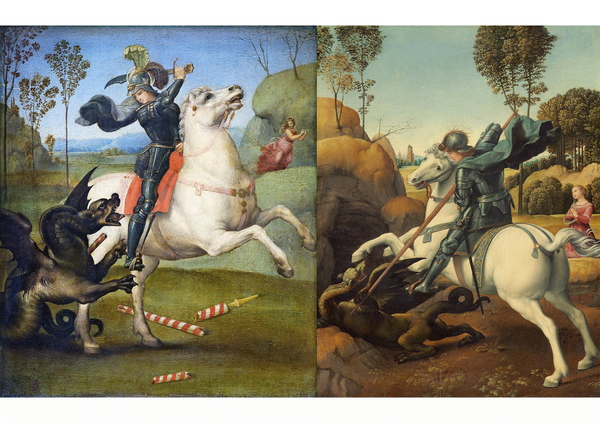
- It sounds very similar the story of Constantine seeing the sign of the cross in the sky before deciding to convert to Christianity.
Constantine's Dream
- Constantine's dream the following night reminds me of the story told about Gediminas, the pagan Grand Duke of Lithuania, before founding the city of Vilnius. It's very possible that all of them are true.
- Constantine's dream also reminds me of Joseph's Dream, with the 11 stars in the sky, which connects back to the original American Flag.
I remember first reading the story of Constantine decades ago in the popular history book Constantine's Sword. Ever since then, I had the phrase "in hoc signo vinces" (in this sign you will win/conquer) seared in my brain. Except, it's not exactly clear what Constantine saw. Did he see a cross, a Chi-Rho (☧), which became his military standard, or a Tau-Rho (⳨) which was a symbol used by early Christians ?
Freedom from Persecution
The Latin I remembered is just a translation from the Greek: ἐν τούτῳ νίκα (en toútōi níka), "in this, be victorious".
Some 200 years after Constantine's vision, the Nika riots took place against Justinian I took place in Constantinople, the city founded by Constantine. What was so interesting about the Nika riots that historically opposing colorful factions the Prasini (Greens) and the Veneti (Blues) were not supporting their own deme or team, but instead, they were all united in shouting "Nika".
They all wanted justice and fairness, not divisiveness, and for that, they used the vision of Constantine, the emperor whose edict protected all religions from persecution.
Which sounds a lot like Homer's 1915 understanding of the American flag.
For some reason I'm reminded of the newsletter on the color pink I sent from Madrid this past summer.
It would be my first time visiting Lithuania, the birthplace of my maternal grandparents, and where they lived until the Nazis placed them on trains to concentration camps located in Poland.
I would learn during my trip that while most countries in Western Europe were expelling Jews, the 14th century Grand Duke Gediminas was expanding Lithuania's territories from the Baltic Sea in the north to the Black Sea in the south. On as color note, baltas in Lithuanian means "white".
To the chagrin of both the Eastern and Western churches, he lived and died a pagan, who was open to religious freedom, and welcomed Jews to live within Lithuania's expanding borders. Over the next 500 years, Jews not only lived there, but they thrived.
 Ezra Butler