How did indigo become violet?
Indigo became violet in the 1990s because of Netscape's co-founder.

It is equally frustrating and fascinating to me that indigo, the historically expensive blue dye, has become associated with a violet hue. And no one seems to mind or care. The answer is, it was because of the halcyon 1990s and the birth of the World Wide Web and the web browser.
But not in the way that Wikipedia tells it.
In the 1980s, programmers produced a somewhat arbitrary list of color names for the X Window computer operating system, resulting in the HTML and CSS specifications issued in the 1990s using the term "indigo" for a dark purple hue. This has resulted in violet and purple hues also being associated with the term "indigo" since that time.
– "Indigo" wikipedia page
If you are a frequent reader of the Colorphilia Newsletter, you probably can guess what I'm going to do. Please enjoy the ride. If this is the first time you are reading the Colorphilia Newsletter, welcome! Please consider a paid subscription to help support my research, or get a free subscription and consider giving a one-time tip. I could use a drink.
In this newsletter, I will show that the first statement above is false.
Indigo became a violet hue in the 1990s. And I can trace the shift to the violet indigo to a single man, James Clark. Yes, the same James Clark who was forced to repatriate $35m of looted Cambodian antiquities in 2022 which he had been using to decorate a penthouse apartment in Miami.
We will see that while it is somewhat true that "[i]n the 1980s, programmers produced a somewhat arbitrary list of color names for the X Window computer operating system", that list did not include the color indigo. We will also see that the various HTML and CSS standards released the 1990s did not, in fact, include the color indigo.
We will see an ethos and culture of collaboration in the 1980s and 1990s which can be seen in the X11 by the X.org Foundation and the W3C. We will see exact color hues debated.
And we will see indigo become co-opted without a word.
James Clark
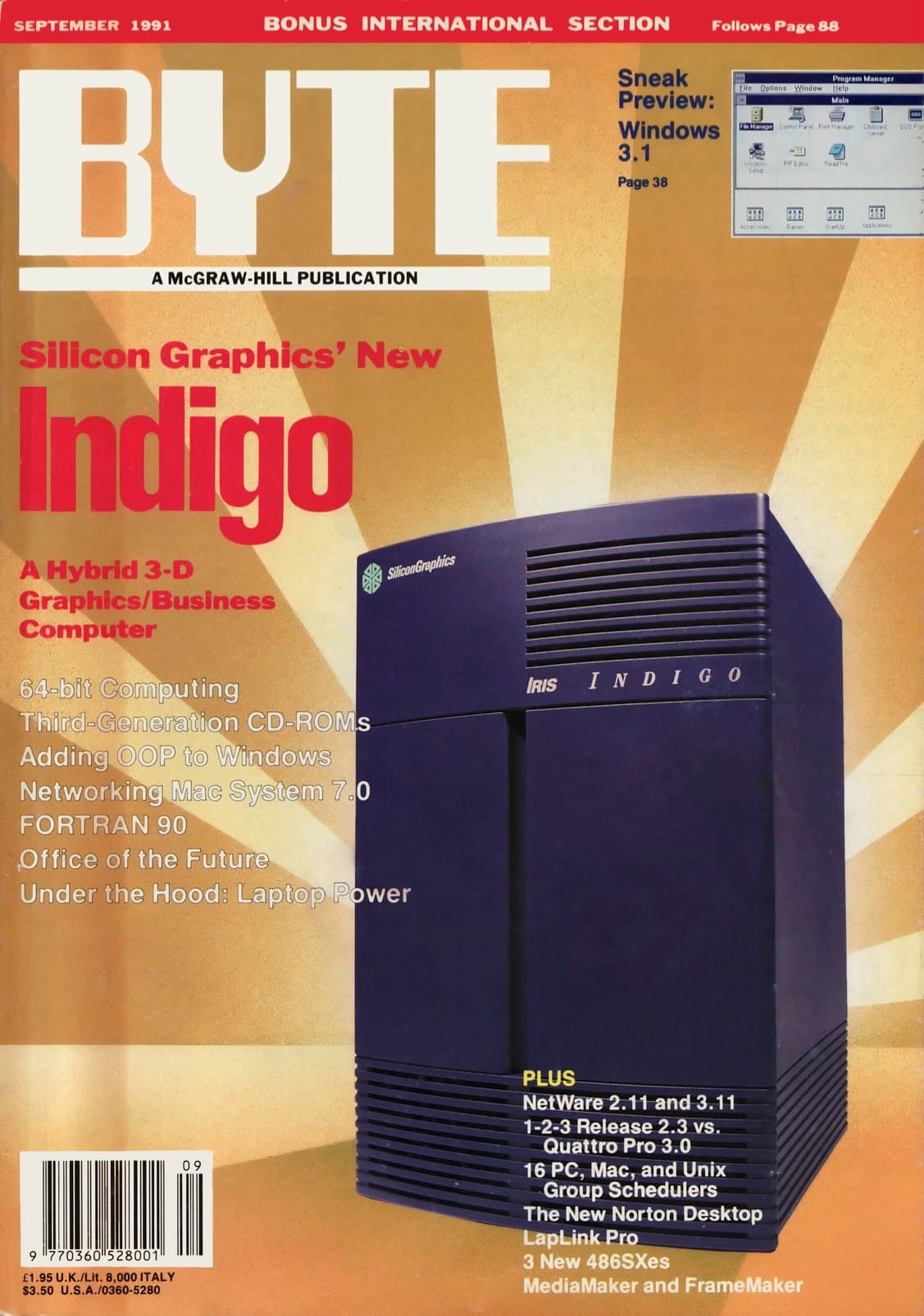
James Clark was one of the founders of Silicon Graphics, or SGI, in November 1981. Their high-end computers were being used to make the original Jurassic Park and Terminator 2, among others. But in 1991, they released a lower-cost, yet still high-end system, which started at $9995. They called it the Indigo, and it was a shade of violet which probably echoed the company logo.
When Clark left SGI, he funded Marc Andreessen from Mozilla and founded the Mosaic Communications Corporation, which was renamed Netscape Communications. Their flagship product, the Netscape Navigator browser, launched in November 1994.
Within the code of that browser, they embedded the color of the indigo (computer) as one of the basic available colors, with an additional 139 colors largely borrowed from an open-source X11 project of the X.org Foundation, which was completed in late 1989.
For the browser which would become the Microsoft Internet Explorer, it seems that they would have borrowed the same file of color names. No one would notice another color or question why it was that specific hue.
Netscape and Microsoft were embroiled in a browser war, both adding their own elements, like <blink> and <marquee>, before coming on board in 1995.
So in November of 1995, representatives form Netscape, Microsoft, IBM, Sun and the W3C (among others) all met in Chicago to hash things out. With just enough people to get things done, this group decided that it would be best to move the HTML standards process away from the IETF and into the W3C, were a tighter and more dedicated group could guide the direction of the HTML standard. This group came to be known as the HTML Editorial Review Board.
https://thehistoryoftheweb.com/blink-marquis-tag/
Over the 1990s, the list of colors was not part of the official W3C standards, but it was used by two of the most dominating members of the W3C. By the time it was added to the official CSS3 standard as a candidate recommendation in May 2003, they had been referring to the entire file as X11 list for nearly a decade.
Rebranding a list
According to the CSS1 specification from December 1996, the 16 colors were used as such:
A color is a either a keyword or a numerical RGB specification.
The suggested list of keyword color names is: aqua, black, blue, fuchsia, gray, green, lime, maroon, navy, olive, purple, red, silver, teal, white, and yellow. These 16 colors are taken from the Windows VGA palette, and their RGB values are not defined in this specification.
https://www.w3.org/TR/REC-CSS1-961217.html#color
However, in an appendix to the working draft of April 1996, there is a list of 140 colors, including the violet indigo, which they end up not using.
Appendix B: Color Names
This table lists color names supported by several current UAs. To ensure similar colors on different devices, the corresponding RGB values are in linear light. These will require gamma correction according to the output device; for illustration, corresponding values are given which may be suitable for PCs (and many workstations) and for Macs.
https://www.w3.org/TR/WD-css1-960418.html
- I believe UAs was the name they used to refer to Netscape Navigator and Microsoft's Internet Explorer
- they did not use the term X11 to describe this list
The X11 connection is first mentioned in a December 1996 post by Robert B. Hess, a Software Design Engineer in the Microsoft Developer Relations Group:
Although these color names are easier to remember than their hexadecimal RGB values, you will quickly find that this set offers rather limited flexibility for color selection.
What you really need is a more robust method for specifying a color. Wouldn't you like to be able to say:<body bgcolor="a light navy blue with a touch of green">
Well, so would I, but I can't. However, you can specify more than 16 colors by name by using the X11 color names.
Originally, the Cascading Style Sheet (CSS) specification from the World Wide Web Consortium (W3C) included a table of "named" colors recommended as part of a standard CSS implementation. The color names they used came from the old X11 implementation, which provides a slightly strange mix of colors and names that has since been adopted by a large number of applications and platforms.
There was a lot of debate and concern regarding the inclusion of these colors in the CSS specification. W3C finally decided not to include them in the final specification, but instead decided to investigate a separate proposal for creating a robust and flexible named color space.
However, these X11 color names do happen to be currently supported by the latest versions of browsers from both Microsoft and Netscape, so I thought it would be useful to provide a visual list for your use.
Archived Version
History of the Actual X11 List
1984 Precursor
In 1984, there was a color display called the VT-240 which had a list of available colors programmers could choose to display, and the accompanying HSL (hue, lightness, and saturation) numbers for 64 different colors, including 13 shades of blue, 12 shades of green, 5 shades of red, 3 shades of gray, firebrick, coral, salmon, khaki and more.
There was obviously no indigo included. It's worth nothing that while there was plum, violet, and three shades of orchid, there was no purple.
The Purple Wars of 1989
The original X11 list was completely by the end of 1989, and would subsequently be included in every X11 system as a rgb.txt file. By the end of 1989, this file would have more than 500 unique colors (which many versions of repeats) including more than 100 shades of gray / grey.
We have the change log for these files which allow us to see when things were added and removed, which also allows us to see the humanity behind the choices.
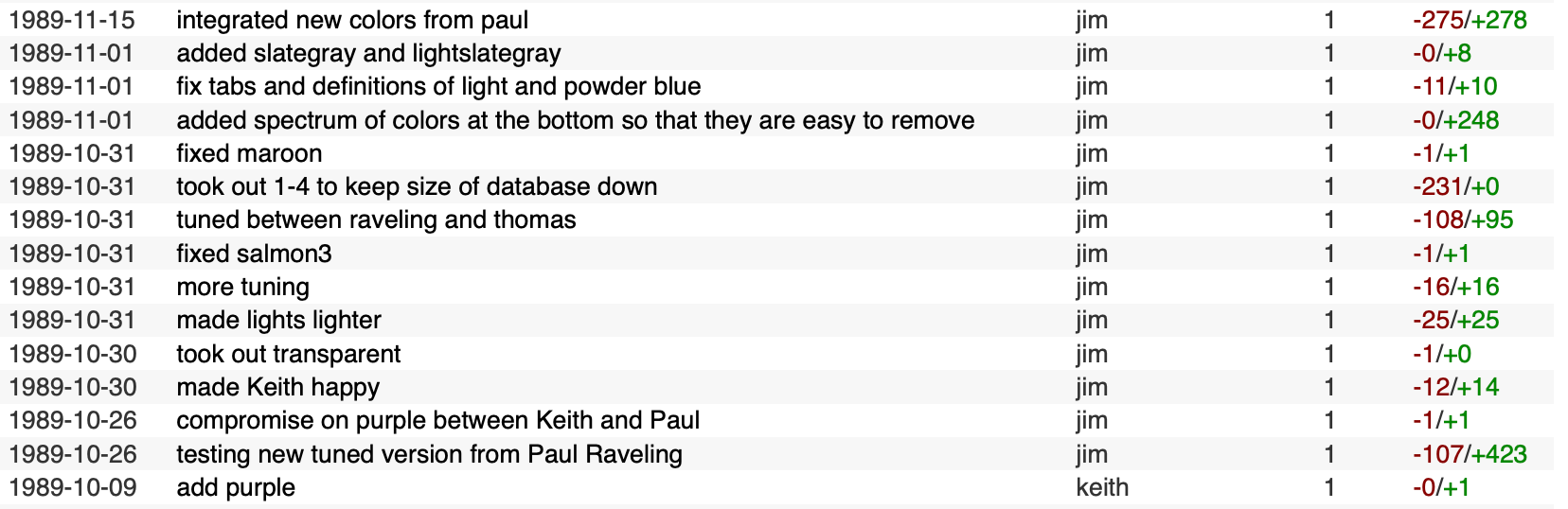
1989-10-09 add purple
1989-10-26 testing new tuned version from Paul Raveling
1989-10-26 compromise on purple between Keith and Paul
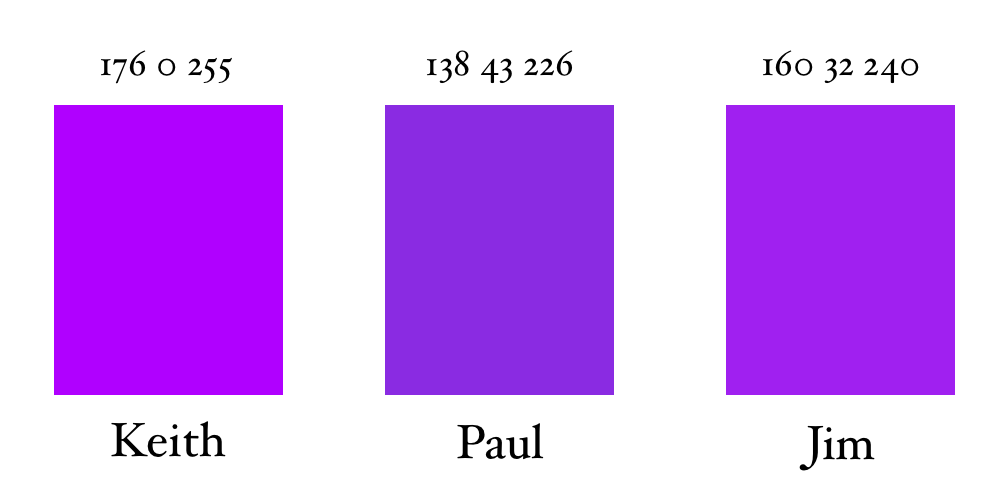
On October 9th, 1989, Keith added a color purple. A few weeks later, Paul submits a slew of colors, including a different, slightly darker purple. That same day, Jim acts like peacemaker and finds a happy medium.
The drama doesn't end. It is obvious that Keith did not like a number of Paul's blues, so to keep the peace, Jim slightly changed some of blues. A few weeks later, Paul changes the blues again.
Whiles these may have been "somewhat arbitrary" as the above-quoted Wikipedia entry insinuates, there is obviously discussion, collaboration, and compromise. And all that is maintained for historical record.
Throughout the 37 revisions over 22 months of intensive editing (until the end of 1989), indigo was not used a single time.
X11 Official
Add missing colors from CSS Color Module Level 4
CSS web colors are based on the X11 rgb.txt file. There are a few colors in CSS that were not in rgb.txt. Update rgb.txt to include all CSS color names. Adding aqua, lime, fuchsia, crimson, indigo, olive, rebecca purple, silver and teal.
ee2c453a748af6fbd0b31569b3b240517b9320f3
Indigo was finally added to official X11 list in June 2014, alongside another personally meaningful color, albeit with a much more beautiful backstory: #rebeccapurple (or #663399) to remember the daughter of web standards advocate Eric Meyer, who passed away on her 6th birthday from a brain tumor.
I have been made aware of the proposal to add the named color beccapurple (equivalent to #663399) to the CSS specification, and also of the debate that surrounds it.
I understand the arguments both for and against the proposal, but obviously I am too close to both the subject and the situation to be able to judge for myself. Accordingly, I let the editors of the Colors specification know that I will accept whatever the Working Group decides on this issue, pro or con. The WG is debating the matter now.
I did set one condition: that if the proposal is accepted, the official name be rebeccapurple. A couple of weeks before she died, Rebecca informed us that she was about to be a big girl of six years old, and Becca was a baby name. Once she turned six, she wanted everyone (not just me) to call her Rebecca, not Becca.
She made it to six. For almost twelve hours, she was six. So Rebecca it is and must be.
– Eric Meyer's Blog

Crayola Postnote
In my opinion, Crayola, which first added a violet indigo crayon in 1999, should replace that with a #rebeccapurple hue instead, and lead the way in returning indigo to its former blue glory.
The bottom line is: Indigo should not be violet, though #rebeccapurple would look beautiful in a rainbow.
 Ezra Butler
 Ezra Butler
 Ezra Butler