Book Review: Basic Color Terms (1969) by Berlin & Kay
Colorphilia Book Review #1
I had heard about Berlin & Kay's seven stage theory long before I ever began researching color. Every time I read the book again, I find new things to appreciate, but I also discover new reasons as to why I question its findings.
Each color listed in their book has a history, and instead of embracing and exploring each history, their research reveals an ahistorical, arbitrary application of rules used to develop a theory which doesn't further our understanding of how people in different cultures use the language of color.
Basic Color Terms: Their Universality and Evolution
Brent Berlin & Paul Kay
Berkley: University of California Press, 1969.
In this very impressive work, Brent Berlin and Paul Kay put forth a theory about the evolution of color in language. There theory states that there are effective seven stages for development of basic color words in languages. Their team had 98 languages taxonomized from all over the world, with extensive mapping for 20 of them.
Have any color-related question or curiosity? Supporters with paid subscriptions may email me a question, and I'll research and write a 500-750 word response.
Please consider a paid subscription to help support my research, or get a free subscription and consider giving a one-time tip.
Stages
Stage I: a language only has two color terms, what they describe as white and black. (2 colors; 9 languages)
Stage II: introduction of red. (3 colors total; 21 languages)
Stage III: introduction of either yellow or green (4 colors total; 17 languages)
Stage IV: introduction of other word for either green or yellow. (5 colors total; 18 languages)
Stage V: introduction of blue. (6 colors total; 8 languages)
Stage VI: introduction of brown (7 colors total; 5 languages)
Stage VII: eight-, nine-, ten- and eleven-term systems. (including purple, pink, orange, gray; 20 languages)
Color words
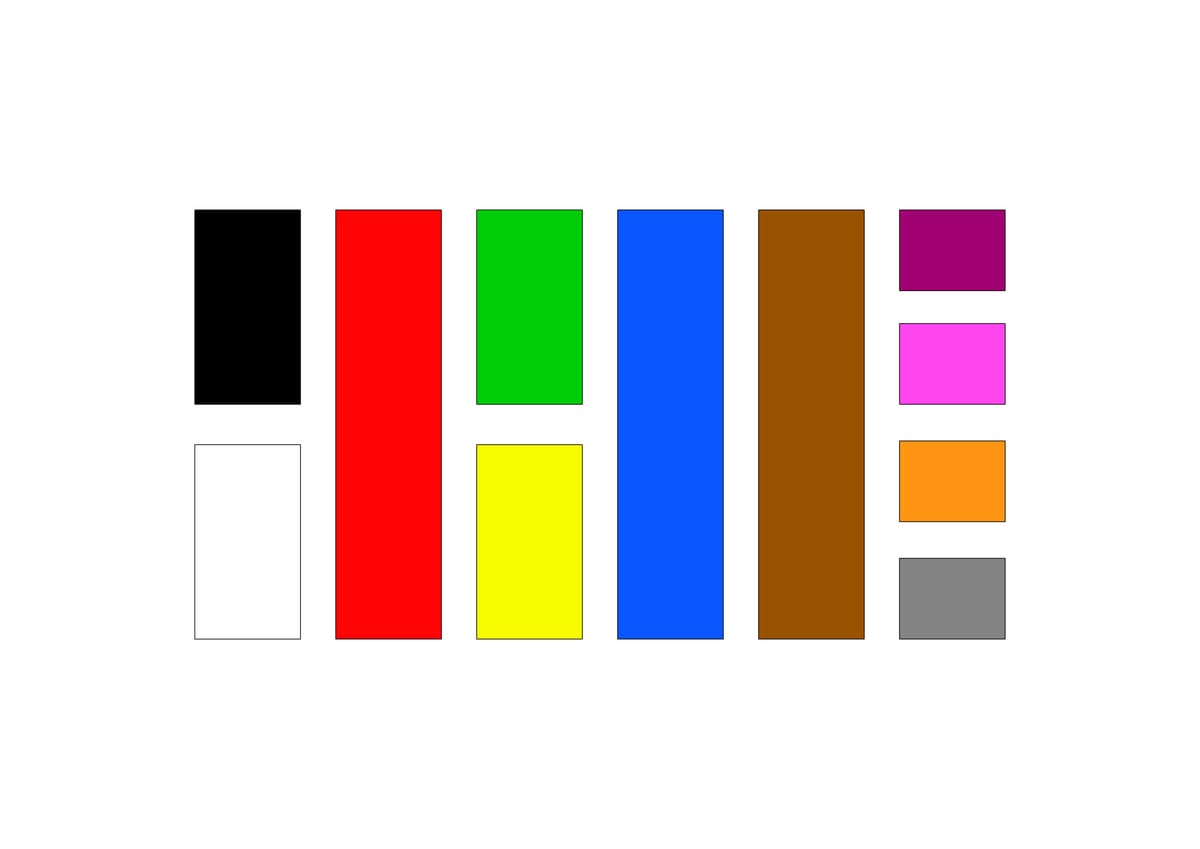
The list of all 11 basic color words for their research are: white, black, red, yellow, green, blue, brown, purple, pink, orange, and gray. Two languages have 12 basic colors: Russia differentiates between dark blue and light blue, and Hungarian has two versions of the color red.
Process
Their procedure began with a set of 329 color chips of equally spaced hues and brightnesses and 9 chips of a neutral hue (white, black, and grays).
The informant would verbally say "his full list of basic color terms", and then:
1) find all the chips which could potentially be described as a specific color,
and 2) identify "the best, most typical examples" of the specific color.
Rules
But they would reject any words like "crimson", "blond", "blue-green", "lemon-colored", and of course, the very common "the color of the rust on my aunt's old Chevrolet".
There were in total 8 rules in accepting a color which may be summarized by this: The word would have to be monolexemic, "that is, its meaning is not predicable from the meaning of its parts", it can't include be part of a subset of another color, such as "crimson" and "scarlet" are hues of "red". And it can't only be used to describe a very narrow set of things, like blond is only used to describe "hair, complexion, and furniture". And it had to be general enough to be applicable to all people, so "the color of the rust on my aunt's old Chevrolet" was a shade too specific. In general, it couldn't also be a recent loan word or the word of an object or substance it resembled, like "gold", "silver" and "ash".
Cross Cultural
They make several notes about cross-cultural issues.
Thus, increase in the number of basic color terms may be seen as part of a general increase in vocabulary, a response to an informationally richer cultural environment about which speakers must communicate effectively. There is also some evidence to suggest that for groups living "close to nature," basic color terms are of relatively little adaptive value because of their broadness of reference (Post, 1962). For example, to a group whose members have frequent occasion to contrast fine shades of leaves and who possess no dyed fabrics, color-coded electrical wires, and so forth, it may not be worthwhile to rote-learn labels for gross perceptual discriminations such as green/blue, despite the psychophysical salience of such contrasts. (p. 16)
I think that one of the problems of this study, like so many anthropological studies is that it misunderstood the function of color and its evolving nomenclature. They understood "English" color to be fully evolved and everyone else must fit in with this rubric.
Tiv [a Bantoid language of Nigeria] can distinguish colors and do color-blind tests, but their culture does not require–or allow–that they make some of the color distinctions that Westerners makes. Westerners are the most color-conscious of peoples. (p.25)
Some problems
We know that one of their Stage I languages, the South Indian Paliyan Tamil, has five different basic color terms which a different researcher, Gardner (in 1966) used to describe the world, from veļļe (illuminated), manja (bright), nīlam (of medium brightness), sihappu (dark), and karappu (dark / in shadow).
But because their stated concept was in relative terms of light and darkness, and not in describing absolute hues, the researchers considered them to be an unevolved language.
For what its worth, the Stage V language of the Plains Tamil used the same exact words to describe colors: veļļe (white), manja (yellow), nīlam (blue), sihappu (red), and karappu (black). They also have paccai (green).
On one hand the book is trying to demonstrate the evolution of the language of color, and on the other hand, its application of its own rules is a bit arbitrary.
Teal would not be accepted as a specific color, but голубой (goluboy) is considered to be light-blue in Russian, which similar to "teal" is named after the plumage of a bird. To contrast with синий (siniy) which is dark-blue, simply indicating that the color was imported originally to Russia from China through mostly overland methods, similar to Bulgaria. Though, the cultures who describe the same color as some version of nil or nila imported it from India in one way or another.
Another root for blue, including blue (from blee), like the Spanish azul or the Hungarian kék are words which originate with the color of the sky. Or the languages which use some derivation of the flowers rosa, lila, or the fruit orange to describe pink, purple, or orange.
And we know that lál in Indian for red was borrowed from Persian to describe the color of the tulip, or the version of Catalan red is vermell from vermilion, which would not be allowed to be as an English shade, because we would have required the roig (related to rojo / roxo).
Similarly, while we may think that white and black are synonymous with light and dark, I've already written about in earlier cultures, the concepts of light and dark are going to be on the spectrum of blue, but that's only referring to night darkness. And that there would be a completely different "dark" for "pit darkness".
Arguably, the word orange comes from the word for golden. It's only been used since the around the 17th century. The Hebrew word for gray "אפור" (afur) comes from the word for "ash".
Added Context
We must remember that the 1960s was just a few decades after we finally achieved the ability to effectively manufacture anything we would like in any color we can imagine. It was also the rise of the era of the social sciences, desperately wanting to show that they could apply objective tools to the world.
So while I appreciate their research and the circumstances of its creation, I feel that their seven stages for the emergence of color terms in languages is flawed in its execution, even though it is logical and sounds correct.
Frequently in my historical research, I see that color words are mistranslated because the original writers appreciated the relative and metaphorical use of color in a way that doesn't fit into the rigid rubric of the modern era.
We only understand Genesis 25:30 to be referring to Esau referring to "red lentils" and that the Red Heifer in Numbers 19:2 to be the color "red", because the root a-d-m is used in both cases. And we know that adom is the word for red in Hebrew.
It is not until II Kings 3:22 where blood is described using that word. But in most other locations in the Bible, that root is referring to a country, a people, the concept of physical land (adama), or even the first man (Adam).
If someone wanted to refer to red clothes, thought they would have used a word which we would literally translate to vermilion. They would be correct to use different words to describe different things which appeared to have the same hue.
Outside of simplicity, there is no objective rationale in limiting the number of colors which people may use to describe things.
More important questions
I wonder how different the results would appear and how this theory would evolve if we were to explore the worlds of each of these language speakers and see how they describe their specific hue of the sea and the sky, at sunrise and sunset, during the day, and throughout the night and month; the differentiation they may use to describe the grasses or trees; which dyes and minerals they have access to and how those words are then used within the rest of the language.
How do they refer to blood and jaundice? What color hair do people have at different stages of their lives? Which flowers and birds and animals and fruits and vegetables are indigenous to the region? What does their poetry describe? What minerals can be found in their local version of clay and dirt?
Is milk described using the same color as chalk? Do they use one word to describe something precious and other word to describe something cheap, even if they are effectively the same color? In fact, how do they describe the galaxy (or in English, "the Milky Way")?
I really want to know: How do they use the colors in their world to paint with words?